
CBG Biotech Pvt. Ltd. provides biogas purification solutions designed to support the treatment and upgrading of raw biogas. Pressure Swing Adsorption (PSA) is a widely used gas separation technology that uses specialised adsorbent materials to separate selected components from a gas mixture under controlled pressure conditions.
A typical PSA system uses multiple vessels containing adsorbent media. Under pressure, the media selectively adsorbs components such as carbon dioxide, water vapour, and, depending on the adsorbent and system configuration, certain other impurities. The pressure is then reduced to regenerate the adsorbent so that it can be used for another cycle. This cyclic process helps produce a methane-rich gas stream suitable for further processing or use when it meets the required quality specifications.
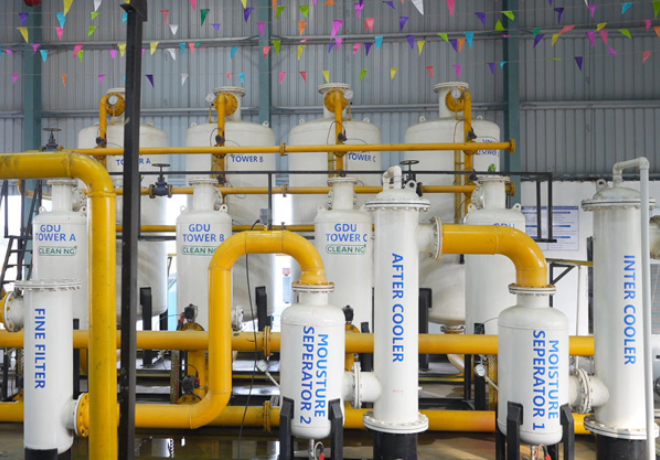
A Pressure Swing Adsorption purification plant is a gas separation system that removes selected components from a gas mixture using adsorbent materials. It works by changing the pressure within adsorption vessels to promote the adsorption and subsequent release of targeted gas components.
In biogas upgrading, PSA technology is commonly used to reduce carbon dioxide concentration and increase the relative methane content. The raw biogas is first conditioned as required to protect the adsorbent and equipment. It then passes through the PSA vessels, where selected impurities are retained by the adsorbent under pressure. A regeneration stage releases the adsorbed components, preparing the media for the next cycle.
The final gas quality depends on the inlet biogas composition, adsorbent selection, vessel configuration, pressure cycle, pretreatment stages, and plant operating conditions.
PSA works through the different adsorption characteristics of gases on a selected solid material. Under the operating pressure, some components are preferentially adsorbed while the desired gas passes through the vessel. The pressure is then reduced to release the adsorbed components and regenerate the material.
Before entering the PSA unit, raw biogas may require moisture removal, hydrogen sulphide reduction, particulate filtration, and other conditioning steps. Appropriate pretreatment helps protect the adsorbent media, supports stable operation, and reduces the risk of premature performance deterioration.
The conditioned biogas is supplied at the pressure required by the PSA system. Pressure supports the adsorption process and influences the separation performance. The operating pressure is selected according to the equipment design, gas composition, and target outlet quality.
The pressurised gas enters a vessel containing specialised adsorbent media. Depending on the media and system design, components such as carbon dioxide and residual moisture are preferentially adsorbed. The methane-rich gas exits the vessel for collection or further processing.
When the adsorbent approaches its operating capacity, the vessel is taken through a regeneration step. Reducing the pressure allows previously adsorbed components to be released. The vessel is then prepared for the next adsorption cycle.
PSA plants use multiple vessels that operate in coordinated cycles. While one vessel adsorbs selected impurities, another may be depressurising, regenerating, repressurising, or preparing for the next cycle. This arrangement enables a continuous treated-gas output even though adsorption within each individual vessel is cyclical.
These pressure-rated vessels contain the adsorbent media and provide the space required for gas separation. Their size, number, and arrangement depend on the gas flow rate, operating cycle, and desired performance.
Adsorbents are selected according to the components that need to be removed. The type and combination of media influence separation performance, regeneration requirements, and operating life. The correct media must be selected for the actual gas composition and plant design.
Automated valves manage the flow of gas through each vessel during adsorption, depressurisation, regeneration, and repressurisation. Pressure instruments and a control system coordinate the sequence to maintain the intended operating cycle.
Depending on inlet gas quality, pretreatment equipment may include filters, moisture removal systems, gas coolers, and hydrogen sulphide removal units. These components help ensure that the PSA system receives gas within its specified operating limits.
The control system coordinates the vessel sequence and monitors key operating parameters. Pressure, temperature, flow, and gas composition measurements can be used to assess performance and support operational troubleshooting.
By adsorbing carbon dioxide and other selected impurities, PSA can increase the methane proportion of the treated gas. The required methane concentration depends on the intended application and the applicable gas quality specification.
The pressure swing cycle allows the adsorbent to release retained components and return to service. This regeneration mechanism is central to the process, although adsorbent life and replacement intervals depend on gas quality, contamination, and operating conditions.
Multiple vessels can be operated in staggered cycles so that the system supplies treated gas while individual vessels regenerate. The actual output profile and plant availability depend on the equipment configuration and control strategy.
PSA plants can be designed for different gas flow rates and inlet compositions. Correct sizing requires assessment of raw biogas quality, target outlet specifications, pressure requirements, and the intended operating schedule.
PSA technology can be considered for biogas upgrading projects where carbon dioxide reduction and methane enrichment are required. Potential applications include:
Whether PSA is suitable for a particular project depends on the gas composition, required product quality, plant capacity, energy requirements, pretreatment needs, and downstream compression or distribution arrangements.
Carbon dioxide is a primary target in many biogas PSA applications. Reducing its concentration increases the relative methane content of the treated gas. Adsorbent selection and cycle design determine the achievable separation performance.
Some adsorbents can retain moisture, but PSA plants generally require appropriate inlet conditioning to control water content and protect the media. The exact moisture removal arrangement depends on the system specification.
The supplied process description lists nitrogen and oxygen among the components that may be addressed by PSA. Their removal depends on the adsorbent characteristics and the specific process configuration. They should not be assumed to be removed to a particular level by every biogas PSA plant.
Hydrogen sulphide control is important for protecting gas treatment equipment and meeting downstream gas quality requirements. PSA adsorbents can be sensitive to certain contaminants, so dedicated upstream H₂S removal is commonly considered where needed. The required arrangement should be confirmed from the plant design and adsorbent supplier specifications.
PSA performance depends on the adsorbent, pressure cycle, gas composition, pretreatment, and operating conditions. Nitrogen and oxygen removal are configuration-specific, and not every PSA system removes them effectively. Final methane concentration, methane recovery, energy consumption, and outlet impurity levels should be confirmed against the project’s technical specification.
For a compressed biogas project, PSA may be used to upgrade raw biogas by reducing carbon dioxide and increasing methane concentration. The treated gas may then proceed through additional conditioning and compression stages, depending on the required product specification and the plant layout.
Gas quality must be assessed across the complete treatment train. Moisture, hydrogen sulphide, oxygen, nitrogen, and other impurities may require dedicated removal or monitoring stages. The overall design should account for methane recovery, energy consumption, safe handling of off-gas, and compliance with the applicable product requirements.
CBG Biotech Pvt. Ltd. supports biogas and renewable energy projects requiring gas treatment and purification. Selecting the right PSA arrangement involves evaluating the raw gas, target product quality, operating capacity, pretreatment needs, and downstream use.
PSA stands for Pressure Swing Adsorption. It is a gas separation technology that uses changes in pressure to adsorb and release selected components from a gas mixture.
Biogas passes through vessels containing adsorbent media under pressure. Selected components, particularly carbon dioxide in many biogas upgrading systems, are retained by the media while methane-rich gas passes through. Pressure reduction then regenerates the adsorbent.
Multiple vessels allow different stages of the process to occur in sequence. While one vessel adsorbs impurities, another can regenerate or prepare for the next cycle, supporting a continuous treated-gas supply.
Yes. Carbon dioxide removal is one of the principal uses of PSA in biogas upgrading. The achievable outlet concentration depends on the adsorbent, cycle design, operating conditions, and inlet gas composition.
Removal depends on the adsorbent media and system configuration. Some systems can address moisture or selected additional gases, but the performance for nitrogen and oxygen must be verified for the specific design.
Depending on the inlet concentration and adsorbent specifications, upstream hydrogen sulphide removal may be required to protect the PSA media and maintain reliable performance. The pretreatment requirements should be confirmed during engineering design.
Yes. PSA is one of the technologies used for biogas upgrading in CBG projects. The complete system must be designed to achieve the required methane concentration, impurity limits, and downstream compression requirements.
Important inputs include biogas flow rate, inlet gas composition, operating pressure, moisture and H₂S levels, target methane concentration, required methane recovery, and the intended product gas specification.
Discuss your raw biogas composition, required methane concentration, and plant capacity with CBG Biotech Pvt. Ltd.
Phone: +91 9936544312 | +91 9211291016
Email: biotechcbgpvtltd@gmail.com