
CBG Biotech Pvt. Ltd. provides biogas treatment solutions designed to support the purification of raw biogas for downstream use. A water scrubber is a gas treatment system that uses water to absorb carbon dioxide (CO₂) and hydrogen sulphide (H₂S) from biogas because these gases are more soluble in water than methane under suitable operating conditions.
Water scrubbing is a physical absorption process. In a typical arrangement, biogas is pressurised and introduced at the bottom of a packed absorption column, while water enters from the top. The gas and liquid move in opposite directions, creating counter-current contact that promotes the transfer of soluble components from the gas into the water.
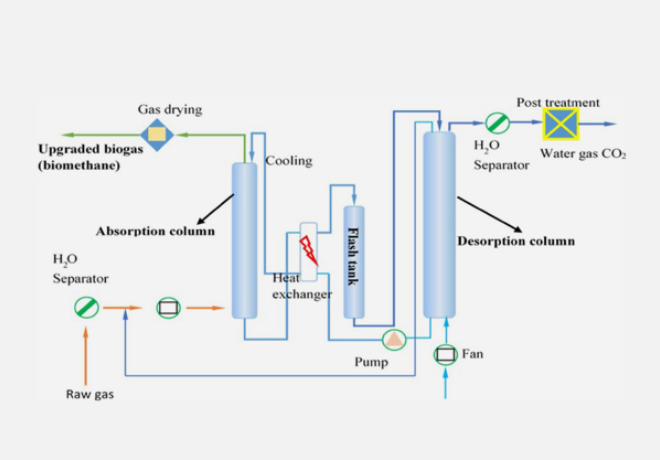
A water scrubber is a gas purification unit used to reduce certain impurities in a gas stream through contact with water. In biogas applications, it can reduce carbon dioxide and hydrogen sulphide concentrations, helping increase the relative methane content of the treated gas.
Raw biogas commonly contains methane and carbon dioxide, along with water vapour and varying amounts of other compounds. The composition depends on the feedstock, digestion process, and plant operating conditions. Removing carbon dioxide is important when upgrading biogas for applications that require a higher methane concentration.
Water scrubbing relies on differences in gas solubility rather than a chemical reaction as its primary absorption mechanism. The performance of the system depends on factors such as pressure, temperature, water flow, gas flow, packing characteristics, and the composition of the incoming biogas.
The water scrubbing process works by bringing pressurised biogas into close contact with water inside a packed column. Carbon dioxide and hydrogen sulphide preferentially transfer from the gas phase into the liquid phase because of their greater solubility in water compared with methane under the relevant operating conditions.
Raw biogas is supplied to the system and pressurised to the operating pressure required by the scrubber design. Pressure influences gas absorption and is one of the main operating parameters considered during system selection and sizing.
The pressurised biogas is introduced at the bottom of a packed absorption column. The packing increases the contact area between the rising gas and the descending water, supporting the transfer of soluble components from the gas into the liquid.
Water is introduced at the top of the column and flows downward over the packing. As the water comes into contact with the rising biogas, carbon dioxide and hydrogen sulphide dissolve into the liquid. The methane-rich gas leaves the upper section of the absorption column.
The gas and water flow in opposite directions. This counter-current arrangement helps maintain a concentration difference between the gas and liquid along the column, supporting mass transfer throughout the absorption process.
After absorbing gas components, the water may require regeneration or treatment before being recirculated, depending on the system design. Water management is important for controlling dissolved gas accumulation, water consumption, discharge quality, and overall process efficiency.
Carbon dioxide is a major non-methane component of many raw biogas streams. Water scrubbing can reduce its concentration, improving the methane proportion of the treated gas. The required degree of CO₂ removal depends on the final application and gas quality specification.
Hydrogen sulphide is more soluble in water than methane and can be absorbed during scrubbing. However, the amount removed depends on operating conditions and inlet concentration. Where strict H₂S limits apply, a dedicated desulphurisation stage may be needed to meet the target specification reliably.
Water scrubbing uses physical absorption as its main separation principle. This can be advantageous in process configurations where water is an appropriate absorption medium and the associated water handling and regeneration requirements can be managed.
Reducing CO₂ increases the methane fraction of the gas stream. Depending on the overall plant configuration, the treated gas may be considered for further upgrading, compression, or utilisation after meeting the relevant gas quality requirements.
Water scrubbing may be considered for a range of biogas treatment applications, including:
The suitability of water scrubbing should be evaluated against the incoming gas composition, required methane concentration, H₂S limits, available water supply, operating pressure, and water treatment requirements.
Pressure and temperature influence gas solubility and absorption performance. The scrubber must be designed and operated within the conditions specified for the selected equipment.
Water quality affects operation, maintenance, and the potential accumulation of dissolved compounds. Water recirculation or regeneration may be used where appropriate, but the arrangement should account for water consumption, dissolved gas release, and wastewater management.
The required methane content and permissible impurity levels vary by application. A water scrubber may need to be combined with other treatment stages, such as dedicated H₂S removal, drying, or additional gas purification, to achieve the complete specification.
Column diameter, packing height, liquid-to-gas ratio, operating pressure, and flow rates influence performance. These parameters should be evaluated using the actual project data rather than selecting equipment based on gas flow alone.
Water scrubbing can reduce CO₂ and absorb H₂S, but the achievable outlet concentrations are dependent on system design and operating conditions. Methane losses, water regeneration, and final gas quality should be evaluated during engineering design. Additional treatment may be necessary to meet the requirements of a CBG or other end-use application.
CBG Biotech Pvt. Ltd. supports biogas and renewable gas projects that require appropriate gas treatment and purification technologies. Each project has different feed gas characteristics, capacity requirements, and end-use specifications, so the treatment configuration should be evaluated against the intended application.
A water scrubber is primarily used to absorb carbon dioxide from biogas. It can also absorb hydrogen sulphide because these gases are more soluble in water than methane under suitable operating conditions.
Biogas is typically pressurised and introduced at the bottom of a packed column, while water enters from the top. The gas rises and the water descends, allowing soluble components to transfer from the gas into the water.
Water scrubbing primarily uses physical absorption. The separation occurs because components such as carbon dioxide are more soluble in water than methane under the operating conditions.
Counter-current operation means that gas and water move in opposite directions through the column. This arrangement helps maintain a concentration difference that supports mass transfer along the packed section.
No specific removal level should be assumed without design data. Water can absorb H₂S, but a dedicated H₂S removal system may be required when the final gas specification sets a low permissible concentration.
Depending on the design, water can be circulated or regenerated for reuse. The system must account for dissolved gases and other compounds that accumulate in the water during operation.
Water scrubbing can be considered as a biogas upgrading technology for CBG projects. Suitability depends on the target methane concentration, impurity limits, operating conditions, and the requirements of downstream compression and gas handling equipment.
Important inputs include raw biogas flow rate, CO₂ and H₂S concentrations, operating pressure, temperature, target outlet gas quality, available water supply, and the intended application of the treated gas.
Contact CBG Biotech Pvt. Ltd. to discuss your biogas composition, purification requirements, and project capacity.
Phone: +91 9936544312 | +91 9211291016
Email: biotechcbgpvtltd@gmail.com
Contact CBG Biotech